

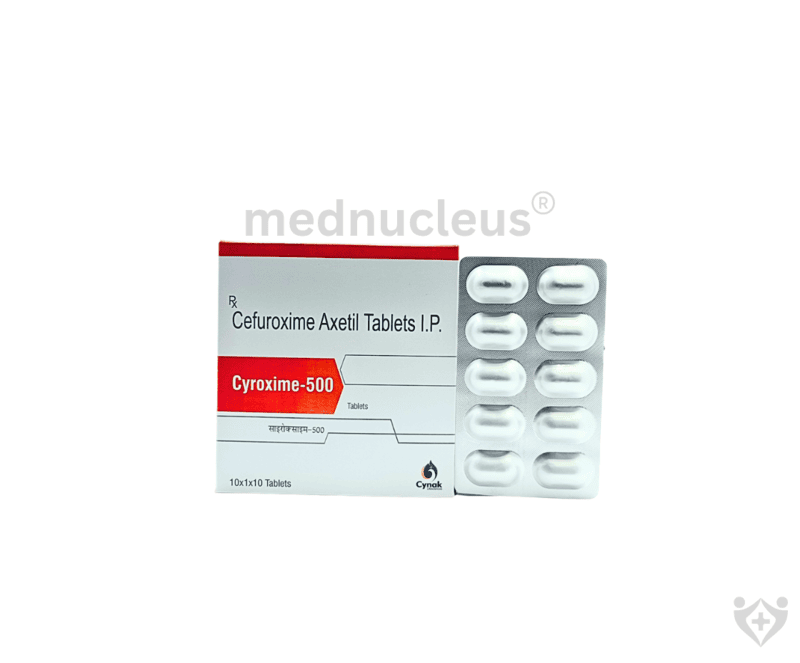
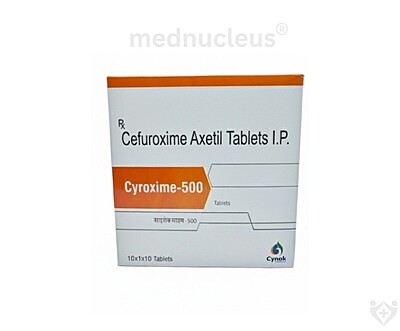
Category Name Anti-Biotics / Second-Generation Cephalosporin Antibiotic
Common Indications CYROXIME-500 is indicated for the treatment of mild to moderate bacterial infections caused by susceptible organisms across a wide range of body systems. It is commonly prescribed for:
- Lower respiratory tract infections including community-acquired pneumonia and acute bronchitis
- Upper respiratory tract infections including sinusitis, tonsillitis, and pharyngitis
- Ear infections (otitis media) caused by susceptible bacteria
- Urinary tract infections (UTIs) including cystitis and uncomplicated pyelonephritis
- Skin and soft tissue infections caused by susceptible organisms
- Bone and joint infections requiring oral cephalosporin therapy
- Lyme disease (early disseminated stage)
- Surgical prophylaxis — prevention of post-operative bacterial infections
- Gonorrhoea and other susceptible sexually transmitted infections
Common Dosings One tablet (500 mg) orally, twice daily — after food for optimal absorption — or as directed by your physician. The dose and duration of therapy may vary based on the type and severity of infection and clinical response. For mild to moderate infections, a course of 5 to 10 days is typically prescribed. Complete the full prescribed course even if symptoms improve early. Do not self-adjust the dose or discontinue therapy without consulting your doctor.
Common Side Effects The following side effects may occur during the course of treatment. Consult your doctor if any of these persist or worsen:
- Nausea or vomiting
- Diarrhoea or loose stools
- Skin rash or urticaria — inform your doctor promptly
- Abdominal discomfort or stomach pain
- Headache or dizziness
- Rarely, severe allergic reactions (anaphylaxis) characterised by facial swelling, difficulty breathing, or severe skin reactions — seek immediate emergency medical attention if these occur
- Signs of Clostridioides difficile-associated diarrhoea such as persistent watery or bloody stools — inform your doctor immediately
- Abnormal liver function tests with prolonged use — inform your doctor if detected on routine blood tests
Common Interactions Inform your doctor about all medications, supplements, and herbal products you are currently taking. Notable interactions include:
- Antacids & Proton Pump Inhibitors (Omeprazole, Pantoprazole): May reduce the absorption of Cefuroxime by elevating gastric pH — administer CYROXIME-500 at least 1 to 2 hours before antacid use for optimal bioavailability
- Warfarin & Other Anticoagulants: Cefuroxime may enhance the anticoagulant effect of Warfarin, increasing the risk of bleeding complications — regular INR monitoring is strongly recommended during concurrent therapy
- Probenecid: May reduce renal excretion of Cefuroxime, increasing its plasma concentration and prolonging its duration of action — dose adjustment may be required under medical supervision
- Oral Contraceptives: Cefuroxime may reduce the effectiveness of hormonal oral contraceptives — consider additional non-hormonal contraceptive methods during and for at least 7 days after completing the antibiotic course
- Live Bacterial Vaccines (Typhoid Vaccine): Cefuroxime may reduce the effectiveness of live bacterial vaccines — vaccination should ideally be completed before or after the antibiotic course
- Aminoglycoside Antibiotics (Gentamicin, Amikacin): Concurrent use may increase the risk of nephrotoxicity — use only under close renal function monitoring
Special Instructions
| Condition | Guidance |
|---|---|
| Pregnancy | Generally considered safe to use during pregnancy at recommended doses. Use only as clearly indicated and under medical supervision with appropriate monitoring throughout therapy. |
| Breastfeeding | Use with caution during lactation. Cefuroxime may pass into breast milk in small amounts. Consult your doctor before use to assess the benefit-risk profile for both mother and infant. |
| Alcohol | The safety of concurrent alcohol use has not been fully established. Alcohol may worsen gastrointestinal side effects and impair recovery — it is advisable to avoid alcohol during the course of antibiotic therapy. |
| Driving & Machinery | It is not fully established whether Cefuroxime alters the ability to drive. Exercise caution and avoid driving or operating heavy machinery if you experience dizziness or any symptoms that affect your ability to concentrate and react safely. |
| Liver Disease | Use with caution in patients with significant hepatic impairment. Regular liver function monitoring may be required during prolonged therapy — consult your physician before use. |
| Kidney Disease | Use with caution in patients with severe renal impairment as Cefuroxime is primarily excreted by the kidneys. Dose reduction based on creatinine clearance and regular renal function monitoring may be required — consult your physician before use. |
Mechanism of Action CYROXIME-500 contains Cefuroxime Axetil, a second-generation oral cephalosporin antibiotic that exerts its bactericidal effect through targeted disruption of bacterial cell wall synthesis:
Cefuroxime Axetil is an ester prodrug that is rapidly absorbed from the gastrointestinal tract and hydrolysed by intestinal esterases to its active form, Cefuroxime. The active drug exerts its bactericidal effect by selectively binding to penicillin-binding proteins (PBPs) located on the inner surface of the bacterial cell membrane. These PBPs are enzymes critical for the final transpeptidation step of peptidoglycan cross-linking — the process responsible for building and maintaining the structural integrity of the bacterial cell wall.
By inhibiting these PBPs, Cefuroxime prevents the formation of cross-linked peptidoglycan chains, weakening the bacterial cell wall and causing it to lose structural integrity. The resulting osmotic instability leads to bacterial cell lysis and death.
A key advantage of Cefuroxime over first-generation cephalosporins is its stability against degradation by many bacterial beta-lactamase enzymes — the primary resistance mechanism employed by many gram-negative bacteria — giving it a broader spectrum of bactericidal activity against both gram-positive and gram-negative organisms, including many beta-lactamase-producing strains.
Instructions to Take
- Take this tablet exactly as prescribed by your doctor
- Always take after food to enhance absorption and reduce the risk of gastrointestinal discomfort — bioavailability of Cefuroxime Axetil is significantly improved when taken with food
- Swallow the tablet whole with a full glass of water — do not crush, split, or chew as the tablet has a bitter taste that may affect palatability and absorption
- Take at evenly spaced intervals (every 12 hours) to maintain consistent antibiotic blood levels throughout the day
- Complete the full prescribed course of antibiotics without interruption — do not stop early even if you feel better, as incomplete treatment may lead to antibiotic resistance or recurrence of infection
- Do not take simultaneously with antacids or PPIs — maintain a gap of at least 1 to 2 hours to ensure optimal drug absorption
- Inform your doctor if you are taking oral contraceptives and consider additional non-hormonal contraception during therapy
- Do not self-medicate, adjust the dose, or share this medication with others
- If a dose is missed, take it as soon as you remember — however, skip the missed dose if it is almost time for the next scheduled dose. Do not double the dose to make up for a missed one
- Ensure adequate hydration during the course of therapy
- Avoid alcohol throughout the course of treatment
- Keep out of reach of children
- Store in a cool, dry place away from direct sunlight and moisture
Disclaimer: This information is intended for general reference purposes only and should not be used as a substitute for professional medical advice, diagnosis, or treatment. Always consult a qualified healthcare professional before starting, changing, or stopping any medication.

