

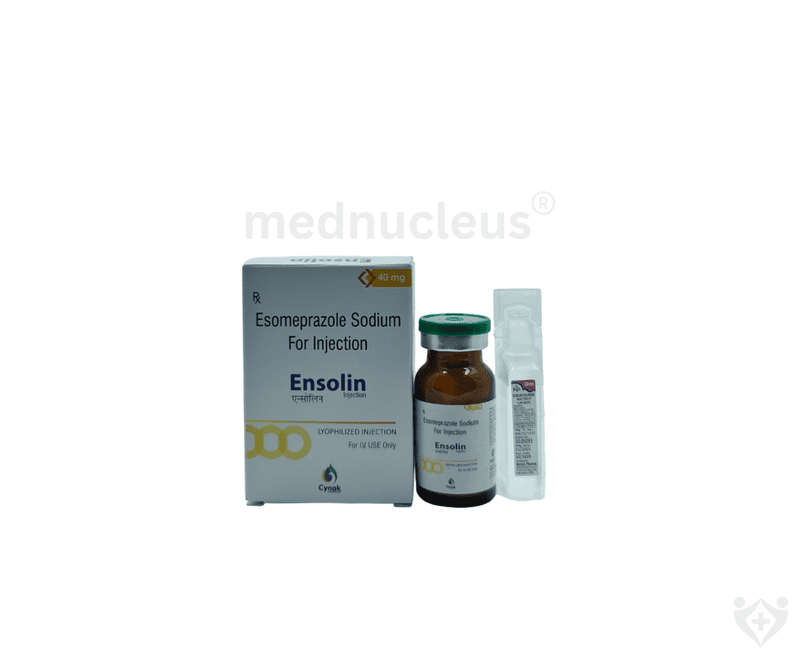
Category Name Gastroenterology — Proton Pump Inhibitor (PPI) — Intravenous Injection (Hospital / Clinical Use)
Common Indications Ensolin Injection is used in hospital settings when oral therapy is not feasible, for:
- Active upper gastrointestinal bleeding from peptic ulcers
- Gastroesophageal Reflux Disease (GERD) — parenteral management
- Erosive esophagitis requiring IV therapy
- Zollinger-Ellison syndrome — high acid output management
- Pre- and post-operative acid suppression
- Stress ulcer prophylaxis in critically ill patients
- Patients who are nil by mouth (NBM) or unable to swallow
Common Dosing
- Standard Adult Dose: 40 mg IV once daily, administered by a healthcare professional
- Upper GI Bleeding: 80 mg IV bolus, followed by continuous infusion 8 mg/hour for 72 hours
- Administration: Slow IV injection over 3 minutes or IV infusion over 10–30 minutes
- Transition: Switch to oral Esomeprazole as soon as patient can tolerate oral medications
For hospital use only — administered exclusively by trained healthcare professionals.
Common Side Effects
- Headache and dizziness
- Nausea, flatulence, and diarrhoea
- Abdominal pain
- Injection site reactions
- Elevated liver enzymes
Seek immediate attention for:
- Severe allergic reaction or anaphylaxis
- Clostridium difficile-associated colitis
- Hypomagnesaemia with prolonged use (muscle cramps, arrhythmia)
Common Interactions
- Ketoconazole, Itraconazole, Atazanavir — Significantly reduced absorption; co-administration not recommended
- Warfarin, Diazepam, Phenytoin — Esomeprazole may increase their plasma levels
- Clopidogrel — May mildly reduce antiplatelet effectiveness
- Methotrexate — Risk of delayed clearance and increased toxicity
Special Instructions
| Condition | Guidance |
|---|---|
| 🤰 Pregnancy | Use only if clearly needed under strict hospital supervision. |
| 🤱 Breastfeeding | May pass into breast milk. Use under medical supervision; consider temporary cessation. |
| 🍺 Alcohol | Not applicable in IV inpatient setting. Avoid alcohol during the treatment period. |
| 🚗 Driving | Not applicable during inpatient IV administration. |
| 🫀 Liver Disease | Use with caution. Dose reduction may be needed in severe hepatic impairment. |
| 🫘 Kidney Disease | Generally safe. No significant dose adjustment usually required. |
Mechanism of Action Esomeprazole Sodium IV is the S-isomer of Omeprazole delivered intravenously for immediate systemic availability. Once activated in the acidic canaliculi of gastric parietal cells, it irreversibly binds to and inhibits the H+/K+ ATPase proton pump — completely blocking gastric acid secretion regardless of the stimulus. The IV route ensures rapid and reliable acid suppression in acute settings where oral dosing is not possible.
Instructions for Administration
- For hospital use only — prepare and administer under trained medical supervision
- Reconstitute with compatible IV diluent (Normal Saline or 5% Dextrose) per product insert
- Administer as slow IV injection (3 minutes) or IV infusion (10–30 minutes)
- Never administer as rapid IV bolus
- Do not mix with other drugs in the same infusion line without confirmed compatibility
- Inspect visually before use — do not use if discoloured or particulate
- Use reconstituted solution promptly
- Transition to oral therapy as soon as clinically appropriate
- Store unmixed vials in a cool, dry place protected from light
This information is intended for general reference purposes only and should not be used as a substitute for professional medical advice, diagnosis, or treatment. Always consult a qualified healthcare professional before starting, changing, or stopping any medication.

