




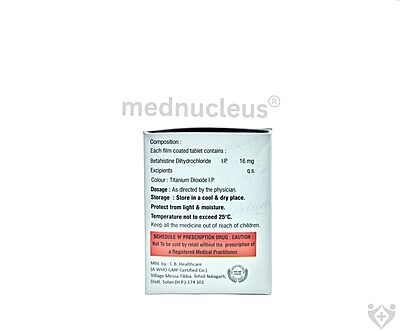
BETAHISTINE IP 16 MG TAB
Category Name ENT & Neurology — Histamine Analogue / Vestibular Disorder Agent
Common Indications
- Ménière's disease — management of the complete symptom triad (vertigo, tinnitus, and hearing loss)
- Vertigo of vestibular origin — dizziness and spinning sensation
- Tinnitus (ringing, buzzing, or noise in the ears)
- Labyrinthine disorders causing balance disturbance
- Vestibular neuritis and labyrinthitis
- Benign Paroxysmal Positional Vertigo (BPPV) — supportive therapy
- Post-traumatic vertigo
- Reduction in frequency and severity of vertigo attacks
Common Dosing
- Standard Adult Dose: 16 mg (one tablet) two to three times daily, with or after meals
- Maintenance Dose: May be reduced to 8–16 mg twice daily once symptoms are controlled
- Duration: Long-term therapy often required for Ménière's disease — typically several months as prescribed
- Take with food to reduce the risk of nausea
Always follow your doctor's prescribed dose and duration.
Common Side Effects Betahistine is generally very well tolerated. Possible mild effects include:
- Nausea and stomach discomfort (most common — take with food)
- Headache
- Mild bloating or indigestion
- Skin rash or itching (rare allergic reaction)
Seek medical attention for:
- Severe gastric pain or worsening GI symptoms (use with caution in peptic ulcer history)
- Skin reactions or signs of allergic hypersensitivity
Common Interactions
- Antihistamines (H1 blockers, e.g., Cetirizine, Diphenhydramine) — May theoretically reduce the therapeutic effect of Betahistine as both act on histamine receptors; concurrent use is generally not recommended
- MAO Inhibitors — May increase Betahistine plasma levels by inhibiting its metabolism; avoid concurrent use
- Beta-2 agonists (bronchodilators, e.g., Salbutamol) — Theoretical interaction via histamine receptor pathways; use with caution in asthmatic patients
Special Instructions
| Condition | Guidance |
|---|---|
| 🤰 Pregnancy | Safety during pregnancy has not been established. Use only under strict medical supervision when benefit clearly outweighs risk. |
| 🤱 Breastfeeding | Insufficient safety data available. Use with caution. Consult your doctor before use. |
| 🍺 Alcohol | Avoid alcohol during treatment. Alcohol worsens vestibular disturbances and can exacerbate dizziness and vertigo. |
| 🚗 Driving | Betahistine itself does not cause sedation and does not generally impair driving ability. However, if vertigo symptoms are not fully controlled, avoid driving until symptoms improve. |
| 🫀 Liver Disease | Use with caution in severe liver disease. Betahistine is hepatically metabolised; impaired function may increase drug levels. |
| 🫘 Kidney Disease | Use with caution in significant renal impairment. Monitor for drug accumulation. |
Mechanism of Action Betahistine is a histamine analogue with a dual mechanism of action on the vestibular system:
- H1 Receptor Agonism (Weak): Betahistine weakly stimulates H1 histamine receptors on blood vessels in the inner ear (cochlea and labyrinth), causing local vasodilation and improving microcirculation to the inner ear. This reduces endolymphatic hydrops (excess fluid pressure in the inner ear) — the primary pathophysiological mechanism of Ménière's disease — thereby decreasing the frequency and severity of vertigo attacks
- H3 Receptor Antagonism (Potent): Betahistine potently blocks presynaptic H3 receptors in the vestibular nuclei of the brainstem. H3 receptors normally act as autoreceptors that inhibit histamine release. By blocking them, Betahistine increases histamine turnover and release in the vestibular pathways, reducing the pathological hyperactivity of the vestibular nuclei that underlies vertigo and balance disturbance
Together these two actions reduce inner ear fluid pressure, normalise vestibular nerve firing, and restore normal balance signal processing — reducing vertigo, tinnitus, and hearing fluctuation in Ménière's disease.
Instructions to Take
- Take with or immediately after meals to minimize the risk of nausea and stomach discomfort
- Swallow whole with a full glass of water
- Take at evenly spaced intervals throughout the day (e.g., morning, afternoon, evening) for consistent vestibular stabilisation
- Do not stop abruptly in long-term Ménière's treatment — discuss any discontinuation plan with your doctor
- Be patient — Betahistine may take 2–4 weeks of regular use before noticeable improvement in vertigo frequency
- Maintain a log of vertigo attacks, frequency, and severity to share with your doctor for dose optimisation
- Avoid sudden head movements and ensure a safe home environment (non-slip mats, handrails) during initial treatment period when vertigo may still be active
- If you miss a dose, take as soon as remembered — if close to the next dose, skip and continue normally. Do not double up
- Store in a cool, dry place away from sunlight and moisture. Keep out of reach of children
This information is intended for general reference purposes only and should not be used as a substitute for professional medical advice, diagnosis, or treatment. Always consult a qualified healthcare professional before starting, changing, or stopping any medication.

