

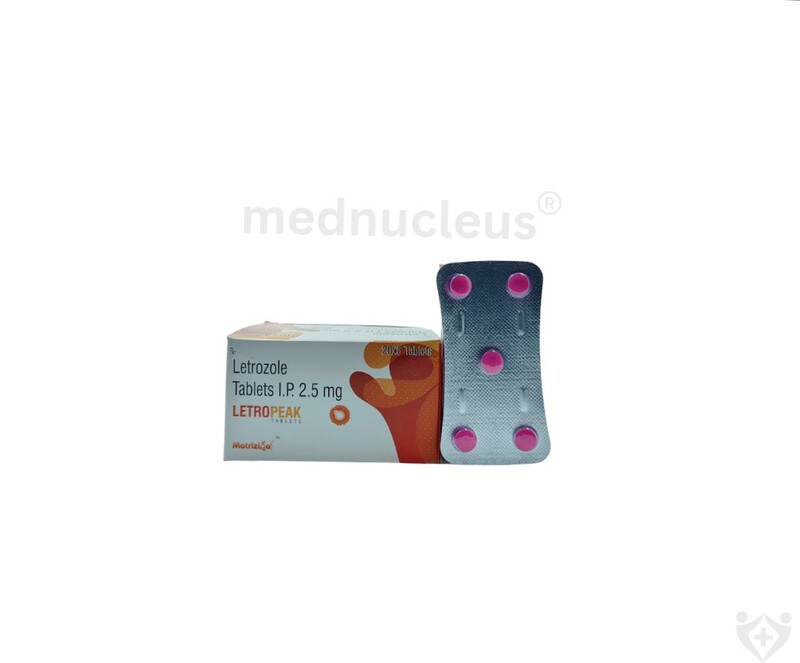
Category Name Oncology & Women's Health — Aromatase Inhibitor (Hormone Therapy / Ovulation Induction Agent)
Common Indications
- Breast cancer treatment — hormone receptor-positive (ER+/PR+) breast cancer in postmenopausal women (first-line and adjuvant therapy)
- Ovulation induction in women with polycystic ovary syndrome (PCOS) — off-label but widely used
- Infertility treatment — stimulation of ovulation in anovulatory women
- Prevention of breast cancer recurrence (extended adjuvant therapy)
- Advanced or metastatic breast cancer after antiestrogen therapy
Common Dosing
- Breast Cancer: 2.5 mg once daily continuously, with or without food
- Ovulation Induction (Infertility): 2.5–7.5 mg once daily for Days 3–7 of the menstrual cycle, as directed by a fertility specialist
- Duration: For breast cancer — long-term continuous therapy (5 years or more) as prescribed
Always follow your oncologist's or fertility specialist's prescribed dose and duration.
Common Side Effects
- Hot flushes and night sweats
- Joint pain and stiffness (arthralgia)
- Fatigue and weakness
- Headache and dizziness
- Nausea
- Bone loss (osteoporosis) with long-term use — requires bone density monitoring
- Mood changes, depression, or anxiety
- Vaginal dryness
Seek immediate attention for:
- Severe bone pain or fracture
- Chest pain or shortness of breath (thromboembolic events — rare)
- Severe liver reactions
Common Interactions
- Tamoxifen — May reduce Letrozole plasma levels; concurrent use is generally not recommended
- Oestrogen-containing products (HRT, oral contraceptives) — Directly counteract Letrozole's hormone-blocking mechanism; avoid concurrent use
- Warfarin — Monitor INR as Letrozole may influence coagulation
- CYP2A6 inhibitors — May increase Letrozole blood levels
Special Instructions
| Condition | Guidance |
|---|---|
| 🤰 Pregnancy | Contraindicated in pregnancy. Letrozole is teratogenic and may cause serious fetal harm. Effective non-hormonal contraception is essential for women of childbearing potential during use outside of fertility treatment. |
| 🤱 Breastfeeding | Contraindicated during breastfeeding. |
| 🍺 Alcohol | Use with caution. Alcohol may worsen bone density loss and fatigue associated with long-term Letrozole therapy. |
| 🚗 Driving | May cause fatigue and dizziness. Exercise caution when driving, especially initially. |
| 🫀 Liver Disease | Use with caution in severe liver disease. Dose adjustment may be required in significant hepatic impairment. |
| 🫘 Kidney Disease | Generally safe in mild to moderate renal impairment. Use with caution in severe renal disease. |
Mechanism of Action Letrozole is a potent, selective, non-steroidal aromatase inhibitor (third generation). Aromatase (CYP19) is the enzyme responsible for converting androgens (testosterone, androstenedione) into oestrogens in peripheral tissues (fat, muscle, adrenal glands) — the primary source of oestrogen in postmenopausal women. By competitively and reversibly inhibiting aromatase, Letrozole suppresses systemic oestrogen levels by over 97%, depriving oestrogen-receptor-positive cancer cells of their growth stimulus. In infertility treatment, the transient reduction in oestrogen feedback stimulates FSH release from the pituitary, promoting ovarian follicle development and ovulation.
Instructions to Take
- Take once daily at the same time each day, with or without food
- Swallow whole with a full glass of water
- Do not stop without consulting your oncologist — for cancer treatment, continuous uninterrupted therapy is essential
- Take calcium and Vitamin D supplements as directed to protect bone density during long-term use
- Attend all scheduled follow-up appointments for bone density monitoring, liver function, and cancer surveillance
- Use effective non-hormonal contraception if of childbearing potential
- If you miss a dose, take as soon as remembered on the same day. If the next day, skip the missed dose — do not double up
- Store in a cool, dry place away from sunlight
This information is intended for general reference purposes only and should not be used as a substitute for professional medical advice, diagnosis, or treatment. Always consult a qualified healthcare professional before starting, changing, or stopping any medication.

